Is It Safe to Repair a Microwave at Home? Expert Advice
Introduction
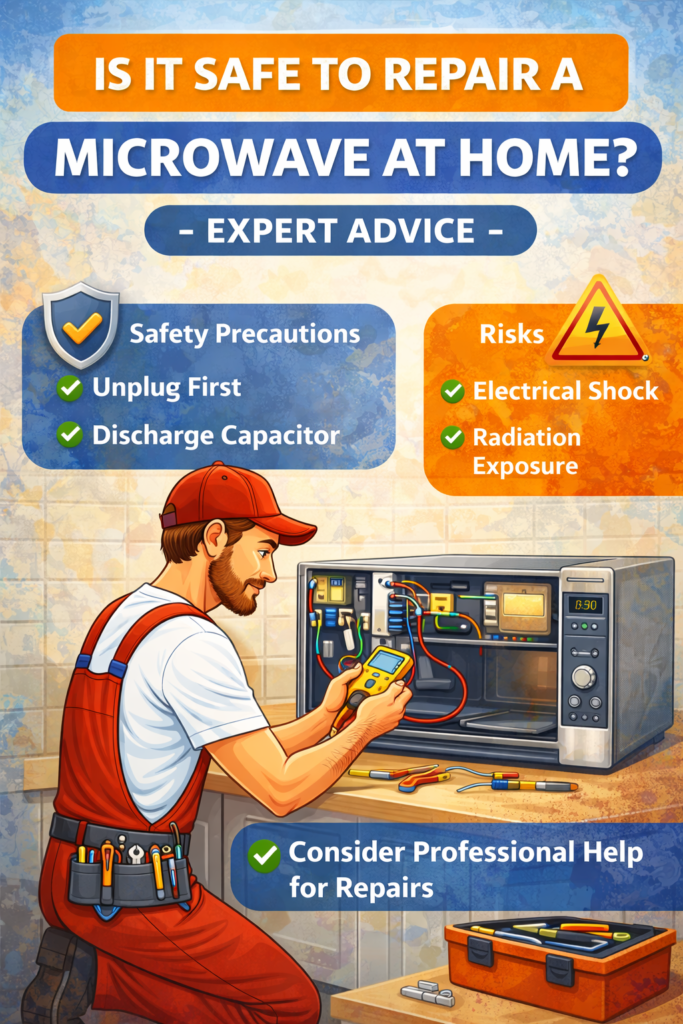
With DIY videos everywhere, many homeowners ask: “Can I repair my microwave oven at home?” The short answer is no—for most repairs, it is unsafe. Microwaves are not like mixers or fans. They operate using extremely high voltage, store electrical energy even after unplugging, and use components that can cause serious injury or death if mishandled.
Why Microwave Ovens Are Dangerous to Repair
Unlike most kitchen appliances, microwaves use a high-voltage power supply (3,000–5,000 volts). Even when unplugged, some parts retain lethal charge.
Key Risks
⚡ Electric shock (fatal voltage levels)
🔥 Fire hazard
☢️ Microwave radiation leakage
🧠 Permanent nerve damage
💥 Component explosion
This is why manufacturers clearly state:
“No user-serviceable parts inside.”
Understanding Microwave Internal Components
To understand the danger, you must know what’s inside.
1. High-Voltage Capacitor (Most Dangerous Part)
Stores electricity even after unplugging
Can discharge thousands of volts instantly
Touching terminals can cause cardiac arrest
⚠️ Professionals discharge capacitors using insulated tools and procedures.
2. Magnetron
Generates microwave radiation
Improper handling can lead to radiation leakage
Extremely sensitive to alignment
A damaged magnetron can leak radiation beyond safe limits.
3. High-Voltage Diode & Transformer
Work together to boost voltage
Mishandling causes arcing and fire
Can destroy control board instantly if replaced incorrectly
4. Door Safety Interlock System
Multiple switches prevent microwave emission when door is open
Incorrect repair may allow radiation leakage
This is not visible danger, but long-term exposure can be harmful.
What Microwave Repairs Are NEVER Safe at Home
🚫 Do NOT attempt the following under any circumstances:
Opening the microwave cabinet
Touching capacitor, magnetron, diode, transformer
Replacing internal wiring
Bypassing door switches
Testing voltage using household multimeter
Using metal tools inside unit
Even trained electricians avoid microwave repair without proper tools.
Are There Any Microwave Checks That Are Safe at Home?
Yes—only non-invasive checks.
✅ Safe DIY Checks (No Tools Required)
Power Supply Check
Try different wall socket
Avoid extension cords
Door Closure Test
Ensure door closes firmly
Check for loose hinges
Control Panel Settings
Ensure power level is 100%
Avoid “Defrost” mode for cooking
Cup of Water Test
Place microwave-safe glass with water
Run 1 minute on High
If water stays cold → internal fault
Visual & Smell Check
Burning smell = stop immediately
Sparks = unplug instantly
If these fail, stop troubleshooting.
Common DIY Myths (Dangerous Beliefs)
Most videos skip safety procedures and disclaimers.
Capacitors store charge for hours or days.
Even small parts are connected to high-voltage circuits.
Microwave repair ≠ standard electrical work.
What Happens When DIY Microwave Repair Goes Wrong
Real-world consequences include:
Severe electric shock
Permanent hand nerve damage
House fire due to improper wiring
Radiation leakage causing long-term health risks
Complete microwave destruction
Voided manufacturer warranty
Insurance claim rejection
When Should You Definitely Call a Technician?
Call a professional if:
Microwave turns on but does not heat
Loud humming or buzzing noise
Burning smell
Repeated fuse blowing
Sparks inside cavity
Error codes
Door not locking properly
Appliance is more than 2 years old
Microwave technicians use:
Insulated discharge tools
High-voltage safety gloves
Radiation leakage meters
OEM spare parts
Cost vs Safety: Is DIY Worth the Risk?
Scenario
DIY Attempt
Professional Repair
Cost
Low upfront
Moderate
Safety
❌ Very high risk
✅ Safe
Warranty
❌ Voided
✅ Preserved
Long-term reliability
❌ Uncertain
✅ Assured
Time
Long & risky
Fast
💡 Saving ₹1,000 is never worth risking your life.
Microwave Repair Cost Overview
Repair Type
Avg Cost (₹)
Door switch
800 – 1,500
Diode
1,200 – 2,500
Capacitor
2,000 – 3,500
Magnetron
4,000 – 7,000
PCB repair
2,500 – 6,000
When Replacement Is Safer Than Repair
Replace your microwave if:
Age exceeds 6–7 years
Magnetron + PCB both failed
Repair cost > 50% of new unit
Repeated failures occur
Modern microwaves are more energy-efficient and safer.
How Professionals Repair Microwaves Safely
Technicians follow strict steps:
Full power isolation
Capacitor discharge
Component isolation testing
Radiation leakage testing
Load testing with calibrated instruments
Safety seal inspection
This level of safety cannot be replicated at home.
How to Reduce Microwave Repair Needs
Use voltage stabilizer
Never run microwave empty
Clean interior weekly
Keep ventilation clear
Avoid slamming door
Use microwave-safe containers only
Frequently Asked Questions (FAQ)
External plug-top fuse only. Internal fuse replacement is unsafe.
Only when door switches or seals are tampered with.
Yes. New models have improved shielding and sensors.
🔴 Microwave ovens should not be repaired at home. The risk of electric shock, radiation exposure, and fire is real and serious. Only basic usage checks are safe for users. Any internal fault must be handled by trained technicians using proper tools.