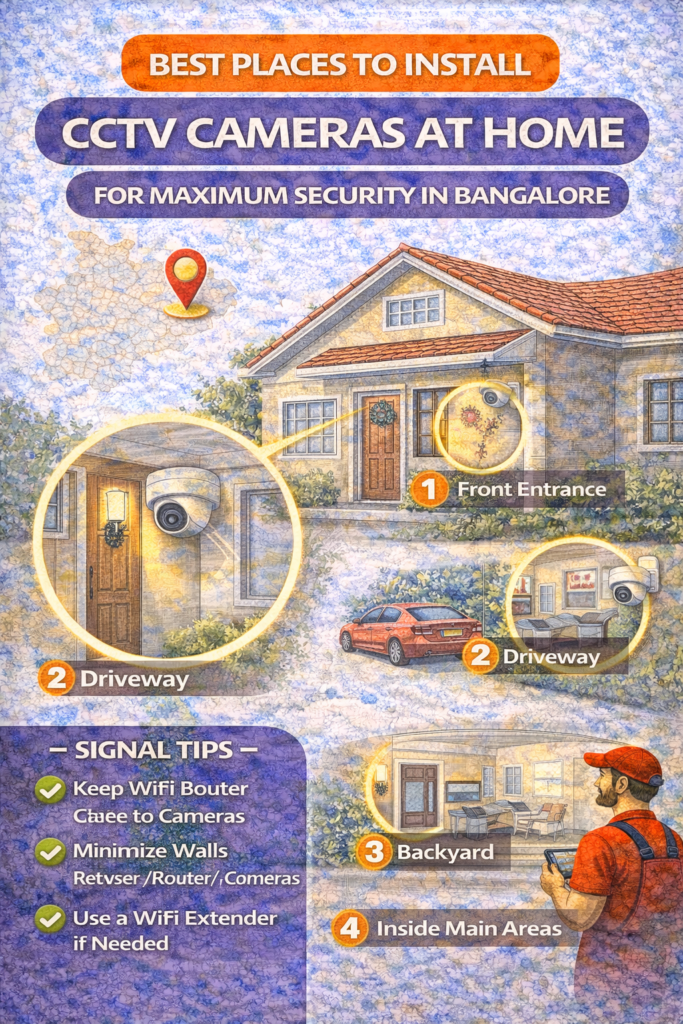
Best Places to Install CCTV Cameras at Home for Maximum Security in Bangalore
You can buy the best CCTV camera, highest resolution, smartest features—and still end up with useless footage if the camera is placed incorrectly.
In Bangalore homes, camera placement matters more than camera brand.
This guide shows you exactly where to install CCTV cameras at home to:
Capture clear faces
Eliminate blind spots
Avoid privacy issues
Maximize deterrence
Get usable evidence, not just recordings
Whether you live in a flat, independent house, or villa, this is the most practical placement guide for 2026.
Why CCTV Camera Placement Is Critical
Wrong placement leads to:
Faces cut off or blurred
Only top-of-head footage
Glare from lights
Missed entry points
Privacy complaints
False sense of security
Right placement gives you:
Identifiable footage
Complete coverage
Fewer cameras needed
Better night performance
Legal & ethical compliance
👉 Placement decides effectiveness.
Golden Rules of CCTV Placement (Read This First)
Before we go room by room, follow these rules:
✅ Cover entry and exit points first ✅ Capture faces, not just movement ✅ Avoid placing cameras too high ✅ Angle slightly downward (10–15°) ✅ Avoid direct light sources ✅ Never install inside bedrooms or bathrooms
These rules alone fix 70% of CCTV mistakes.
1.Best Place: Main Entrance Door (MOST IMPORTANT)
Why this location matters
90% of intrusions start here
Visitors, deliveries, helpers, staff—all pass through
Most valuable footage point
Best placement
Inside the house
Facing the door
Height: 7–8 feet
Dome camera preferred
What it captures
Clear facial shots
Entry/exit time
Visitor identification
❌ Avoid installing outside facing in (privacy + glare issues)
2.Living Room / Hall Area
Why install here
Central movement area
Covers multiple room paths
Helps track activity flow
Best placement
Corner wall
Height: 8–9 feet
Wide-angle lens (2.8mm ideal)
Covers
Movement between rooms
Unauthorized access
General monitoring
📌 One well-placed camera here can replace 2 badly placed ones.
3.Corridor / Hallway (High Value, Often Ignored)
Why corridors are critical
Everyone passes through
Excellent for face capture
Connects all rooms
Best placement
End of corridor
Facing inward
Height: 7–8 feet
This is one of the highest ROI camera locations in flats.
4.Balcony / Utility Area (Apartments)
Why it matters
Secondary access point
Common theft entry
Often overlooked
Best placement
Indoor camera (inside facing out)
Height: 8–9 feet
Avoid rain exposure
❌ Do NOT use indoor cameras exposed to weather.
5.Staircase (Duplex / Independent Homes)
Why install here
Movement between floors
Secondary access route
Low visibility area
Best placement
Mid-landing
Facing downward flow
Height: 8–10 feet
This helps track movement direction, not just presence.
6.Main Gate (Independent Houses & Villas)
Mandatory for houses
Best placement
Outdoor bullet camera
Height: 9–12 feet
Slight downward angle
Why bullet cameras work best
Long-range night vision
Visible deterrence
Weatherproof
📌 Make sure faces are visible before someone reaches the gate.
Too high = useless footage Too low = tampering risk
Indoor vs Outdoor Placement Logic (Simple)
Indoor cameras → Face clarity, movement tracking
Outdoor cameras → Deterrence, perimeter security
A strong home setup uses both strategically.
Lighting & Night Vision Placement Tips
Avoid: ❌ Facing tube lights ❌ Facing windows ❌ Reflective surfaces ❌ IR bounce-back from walls
Best practice:
Install camera slightly away from walls
Angle away from light sources
Test night view before final fixing
How Many Cameras Are Enough? (Placement-Based Answer)
1BHK: 1–2 cameras
2BHK: 3–4 cameras
Independent house: 5–7 cameras
Villa: 6–10 cameras
👉 Correct placement > more cameras
Common Placement Mistakes to Avoid
❌ Camera too high (ceiling center) ❌ Only outdoor cameras, no indoor ❌ Ignoring corridor ❌ Facing sunlight ❌ Random angles ❌ No testing after installation
Always test:
Day footage
Night footage
Motion alerts
Face clarity
Legal & Privacy Considerations (Bangalore)
You must:
Avoid capturing neighbor’s private areas
Inform residents/staff if applicable
Follow apartment association rules
CCTV is legal—privacy violations are not.
Final Placement Strategy (2026 Ready)
If you remember only one thing:
Install cameras where people pass, not where space is empty.
Start with: 1️⃣ Entry points 2️⃣ Movement paths 3️⃣ Blind spots 4️⃣ Perimeter areas