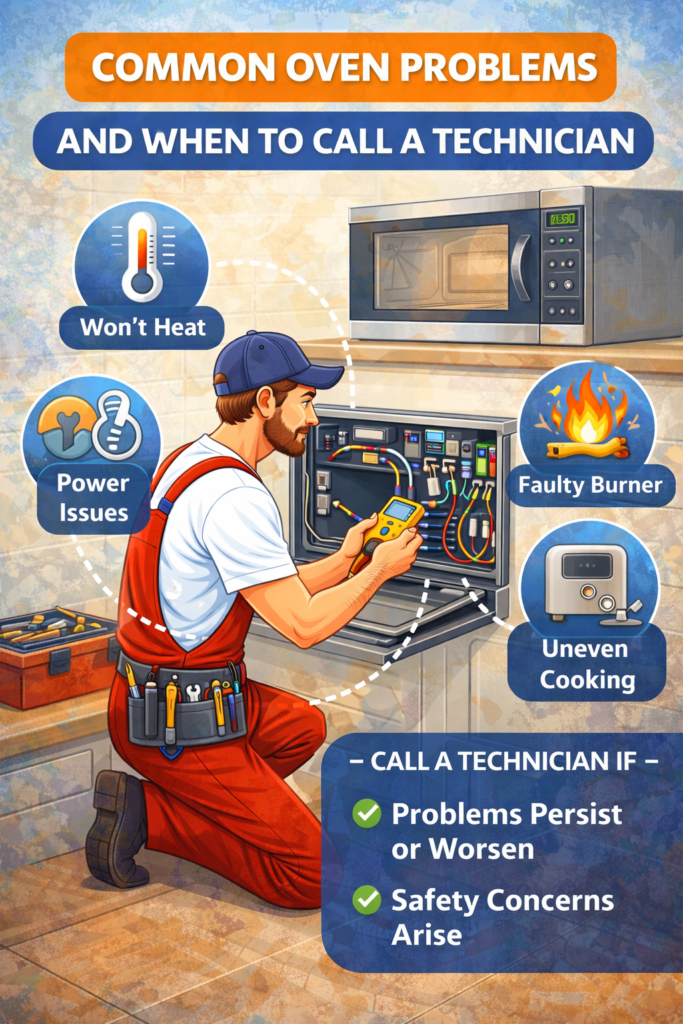
Common Oven Problems and When to Call a Technician
Introduction
Modern kitchens rely heavily on ovens—whether OTG (Oven Toaster Grill) units, built-in electric ovens, or convection ovens. When an oven stops working correctly, cooking becomes inconsistent, time-consuming, and sometimes unsafe. Many users delay repairs, assuming the issue is minor, which often leads to higher costs and permanent damage.
Types of Ovens Covered in This Guide
OTG ovens
Built-in electric ovens
Convection ovens
Combination oven units
(Gas ovens are excluded due to different diagnostics.)
How an Oven Works (Simplified)
An electric oven relies on:
Heating elements (top & bottom)
Temperature sensor / thermostat
Control board (PCB)
Fan motor (convection models)
Door seal (gasket)
If any one component fails, the oven’s performance drops or stops completely.
1. Oven Not Heating at All
Symptoms
Oven powers on but remains cold
No temperature rise even after preheating
Display works, but food doesn’t cook
Common Causes
Burnt heating element
Faulty temperature sensor
Control board failure
Power supply issue
Safe Home Checks
Confirm correct cooking mode
Try another power socket
Check circuit breaker
When to Call a Technician
Heating element replacement
Sensor calibration
Internal wiring or PCB issues
⚠️ Heating elements operate on high current—DIY replacement is unsafe.
2. Oven Heating Unevenly
Symptoms
Food cooked on one side only
Burnt edges, raw center
Baking results inconsistent
Causes
Fan motor failure (convection ovens)
Blocked air vents
Incorrect rack placement
Uneven heating element output
What You Can Do
Avoid overcrowding
Preheat properly
Place trays on center rack
Technician Required When
Fan motor not spinning
Element partially burnt
Temperature fluctuation exceeds ±20°C
3. Oven Temperature Not Accurate
Symptoms
Food overcooks or undercooks
Baking recipes fail repeatedly
Oven reaches temperature too fast or too slow
Causes
Faulty thermostat
Defective temperature sensor
Control board miscalibration
Why This Is Serious
Incorrect temperature damages:
Cakes
Bread
Meat texture
Energy efficiency
Professional Repair Needed
Sensor replacement
Thermostat recalibration
PCB programming
4. Oven Takes Too Long to Preheat
Symptoms
Preheating exceeds 20–25 minutes
Temperature rises very slowly
Causes
Weak heating element
Power supply issue
Voltage fluctuation
Aging oven components
Technician Intervention Required If
Element output is reduced
Voltage draw is inconsistent
Repeated preheating failure occurs
5. Oven Fan Not Working (Convection Ovens)
Symptoms
No air circulation sound
Uneven baking
Burning smell
Causes
Fan motor failure
Wiring issue
Fan blade obstruction
Risks of Continued Use
Overheating
Element damage
Fire hazard
Always Call a Technician
Fan motors require electrical isolation and proper testing.
6. Oven Turns Off Mid-Cooking
Symptoms
Oven shuts down unexpectedly
Restarts after cooling
Error codes appear
Causes
Overheating protection triggered
Faulty thermal fuse
Control board failure
Poor ventilation
Immediate Action
Stop using the oven
Check air vents
Do not restart repeatedly
Technician Needed
Thermal fuse and overheating issues must be addressed professionally.
7. Oven Door Not Closing Properly
Symptoms
Heat escaping from door
Longer cooking times
Hot exterior surfaces
Causes
Worn door gasket
Bent hinges
Door misalignment
Why This Matters
Energy wastage
Inaccurate cooking
Safety hazard
Repair Type
Door seal replacement
Hinge realignment
This is a moderate-cost repair but critical for performance.
8. Oven Producing Burning Smell or Smoke
Symptoms
Smoke during baking
Persistent burning odor
Smoke even without food
Causes
Food residue
Oil buildup
Insulation damage
Electrical overheating
What to Do Immediately
Switch off oven
Unplug
Do not continue use
Technician Required When
Smell persists after cleaning
Smoke appears from control panel
Wiring insulation is damaged
9. Oven Control Panel Not Responding
Symptoms
Buttons not working
Touch panel frozen
Display flickering or blank
Causes
Moisture ingress
PCB failure
Voltage surge damage
DIY Is NOT Recommended Control boards are sensitive and expensive.
Professional Repair
PCB repair or replacement
Software reset or reprogramming
10. Oven Trips Circuit Breaker
Symptoms
Power cuts when oven starts
MCB trips repeatedly
Causes
Short circuit
Faulty heating element
Wiring insulation failure
Immediate Action
Stop using oven
Do not reset breaker repeatedly
Technician Required
Electrical safety risk—must be inspected professionally.
Cost of Common Oven Repairs
Problem
Approx Cost (₹)
Heating element
2,500 – 5,000
Fan motor
3,000 – 6,000
Temperature sensor
1,800 – 3,500
Door gasket
1,200 – 2,500
PCB repair
3,500 – 8,000
Thermal fuse
1,500 – 2,800
💡 If repair cost exceeds 50–60% of oven price, replacement is advisable.
When Should You Replace Instead of Repair?
Replace the oven if:
Age exceeds 8–10 years
Multiple components failed
Spare parts unavailable
Repeated breakdowns occur
Energy consumption is high
New ovens offer:
Better insulation
Accurate temperature control
Improved safety sensors
Lower electricity usage
How to Prevent Oven Problems
Clean interior weekly
Avoid spills on heating elements
Preheat correctly
Use proper bakeware
Do not slam oven door
Ensure ventilation clearance
Use voltage stabilizer if needed
Frequently Asked Questions (FAQ)
Not recommended. High current and insulation risks are involved.
Usually due to fan or temperature sensor failure.
Yes, especially for convection and built-in ovens.
Occasional smoke from spills is normal. Persistent smoke is not.
Final Verdict
Ovens are precision heating appliances, not simple electrical devices. Minor symptoms often indicate deeper internal faults. Ignoring early signs leads to costly repairs, safety hazards, and poor cooking results.
✔️ Basic usage checks are safe ❌ Internal repairs are not DIY-friendly ✔️ Timely professional repair saves money and extends lifespan