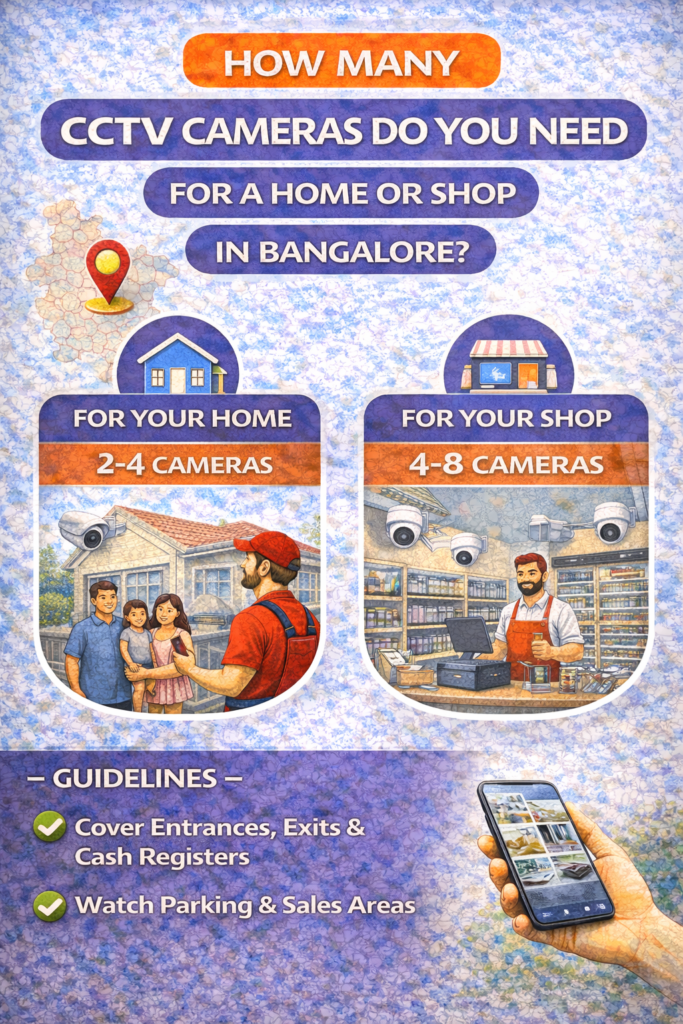
How Many CCTV Cameras Do You Need for a Home or Shop in Bangalore?
One of the most common (and costly) mistakes people make with CCTV is asking the wrong question:
❌ “How many cameras should I buy?” ✅ “How many cameras do I actually need for proper coverage?”
In 2026, effective CCTV planning is about coverage, angles, and purpose—not stuffing cameras into every corner. This guide helps you calculate the exact number of CCTV cameras required for your home, apartment, villa, shop, or office, based on real-world Bangalore properties.
Why Camera Count Matters More Than Ever
Installing too many cameras:
Increases cost unnecessarily
Creates blind spots due to overlap
Complicates monitoring and storage
Installing too few cameras:
Misses entry points
Fails to capture faces clearly
Makes footage useless in incidents
👉 The right number = maximum security + optimal cost
Step 1: Identify Your Property Type
Your property type decides 80% of the camera count.
Common Bangalore setups:
1BHK / Studio apartment
2BHK / 3BHK apartment
Independent house
Villa
Small shop
Large shop / showroom
Office / warehouse
Each has different risk points.
Step 2: Understand the Purpose of CCTV
Before counting cameras, define why you need them:
Monitor entry/exit
Prevent theft
Monitor staff
Keep eye on kids/elders
Evidence recording
Remote viewing
📌 One camera can serve only 1–2 purposes effectively.
CCTV Camera Count for Homes (Detailed)
1BHK / Studio Apartment
Recommended: 1–2 cameras
Best placement:
Main door (inside facing)
Living area (optional)
Why:
Single entry point
Minimal internal movement
Avoid: ❌ Bedroom coverage (privacy issue)
2BHK / 3BHK Apartment
Recommended: 3–4 cameras
Ideal coverage:
Main door
Living room
Corridor / hallway
Balcony / utility area (optional)
Why:
Covers all access paths
Captures movement between rooms
Independent House
Recommended: 5–7 cameras
Suggested layout:
Front gate (bullet camera)
Parking area
Main door
Living room
Backyard / side entry
Staircase (if applicable)
👉 Outdoor coverage becomes critical here.
Villa / Duplex
Recommended: 6–10 cameras
Coverage areas:
Front gate
Back gate
Parking
Garden
Main door
Living area
Staircase
Terrace access
📌 Villas need perimeter-focused planning, not just interiors.
CCTV Camera Count for Shops & Businesses
Small Shop (Under 500 sq ft)
Recommended: 2–3 cameras
Coverage:
Entry door
Cash counter
Storage area (optional)
Why:
Theft prevention
Staff monitoring
Evidence during disputes
Medium Shop / Showroom
Recommended: 4–6 cameras
Coverage:
Entrance
Billing counter
Product aisles
Storage
Exit
👉 Dome cameras work best for interiors.
Office / Warehouse
Recommended: 6–16+ cameras
Depends on:
Floor size
Entry points
Sensitive zones
Compliance needs
Critical areas:
Entry/exit
Server rooms
Inventory areas
Workstations
Loading docks
One Camera ≠ One Room (Big Misconception)
Camera coverage depends on:
Lens angle (2.8mm vs 3.6mm)
Mounting height
Room shape
Obstructions
Example:
One wide-angle camera can cover a small room
A long corridor may need 2 cameras
👉 Coverage > camera count
Indoor vs Outdoor Camera Count Balance
Typical Home Ratio
60–70% indoor
30–40% outdoor
Independent House / Villa Ratio
40–50% indoor
50–60% outdoor
Outdoor cameras often require:
Better night vision
Weatherproof casing
Strategic angles
How Camera Resolution Affects Count
Higher resolution ≠ fewer cameras (always).
4MP cameras give good face clarity
8MP cameras give zoom clarity
But blind spots still exist
📌 Use resolution to improve clarity, not reduce camera count blindly.
DVR / NVR Channel Planning (Very Important)
Always plan for future expansion.
Example:
Need 4 cameras today → buy 8-channel DVR
Need 6 cameras today → buy 8 or 16-channel DVR
Why?
Adding cameras later becomes easy
Saves money long-term
Common Over-Installation Mistakes
❌ Camera in every room ❌ Multiple cameras covering same angle ❌ Ignoring outdoor coverage ❌ Installing cameras too high ❌ Covering privacy-sensitive areas
More cameras ≠ better security.
Common Under-Installation Mistakes
❌ No camera at main entry ❌ Ignoring blind spots ❌ No outdoor camera for independent homes ❌ Only one camera for large shop
Under-installation makes CCTV pointless.
Simple Camera Count Formula (Quick Use)
Ask these 4 questions:
How many entry/exit points?
How many blind spots?
Do I need indoor monitoring?
Do I need outdoor monitoring?
👉 Each YES = at least one camera.
FAQs – CCTV Camera Count
Rarely. Only if open layout and wide angle.
Yes—if DVR/NVR supports expansion.
No. Placement logic remains same.
No. Privacy risk.
Yes. Camera count directly affects HDD size.
Final Recommendation
The right number of CCTV cameras is not a fixed number—it’s a calculated decision.
A well-planned setup:
Needs fewer cameras
Delivers better footage
Saves money
Avoids privacy issues
Scales easily in future
If you’re unsure, always plan coverage first, count second.